The F1 vs F1B Bernedoodle question often begins with coat and shedding. Families see two generation labels and assume one will deliver a specific look, personality, or allergy outcome. Genetics are not that tidy.
Generation labels explain parentage. They do not describe every puppy in a litter, guarantee a coat type, or tell you which individual will fit your home. Use the label as a starting point, then look at the parents, the puppy, and the breeder’s transparency.
What Is an F1 Bernedoodle?
An F1 Bernedoodle is a first-generation cross between a Bernese Mountain Dog and a Poodle. On paper, the puppy receives half of its ancestry from each parent breed. In real life, siblings can still differ in coat texture, furnishings, size, color, confidence, activity, and shedding.
Many F1 coats are wavy or loose, but some are curlier or straighter. Families should not choose an F1 puppy based only on an online photo of another dog.
What Is an F1B Bernedoodle?
An F1B Bernedoodle is commonly produced by pairing an F1 Bernedoodle with a Poodle. This increases the Poodle proportion in the pedigree. Breeders sometimes use other backcrosses, so ask exactly who the parents are instead of relying on the shorthand.
F1B Bernedoodles are often associated with curlier coats and lower shedding, but those are tendencies, not guarantees. Coat testing, parent coats, and the breeder’s experience with the lines provide additional context.
F1 vs. F1B Bernedoodle Coat Differences
F1 Coat Possibilities
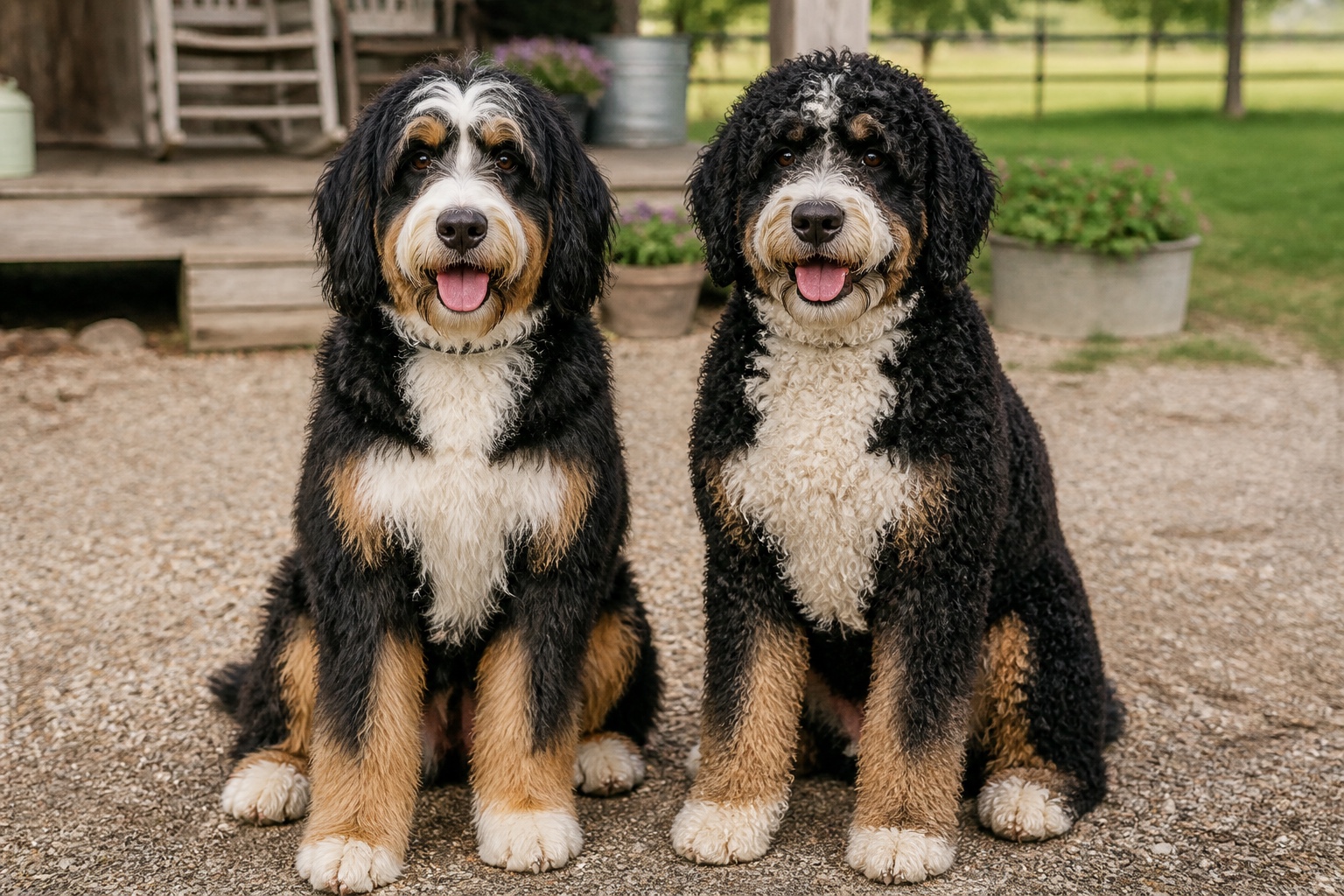
An F1 coat may be straight, wavy, or curly. A looser coat can be easier to see through, but it may release more hair. A dense wavy coat can still mat when the top looks smooth.
F1B Coat Possibilities
An F1B coat is more likely to show strong Poodle influence, including curls and furnishings. Curl does not mean easy care. Dense curly coats can require very consistent brushing, combing, and professional grooming.
No responsible comparison should promise a maintenance-free Bernedoodle. Both generations need routine doodle coat care.
Do Bernedoodles Shed?
Yes, Bernedoodles can shed. Some shed very little, some release noticeable hair, and coat changes can occur as a puppy matures. The phrase ‘hypoallergenic’ is often misunderstood; no dog can be guaranteed not to trigger an individual person’s allergies.
If allergies are a major concern, speak with your healthcare professional and spend time around adult dogs with similar coats when possible. Do not make a high-stakes decision from a generation percentage alone.
Temperament Is More Than a Generation Label
Both F1 and F1B Bernedoodles may be affectionate, intelligent, playful, observant, or sensitive. The personalities of the parents, early environment, individual development, and the family’s training all matter.
A higher Poodle percentage does not automatically make a puppy more energetic or more trainable, and an F1 label does not guarantee a calmer dog. Ask the breeder how each puppy behaves during ordinary handling, play, novelty, recovery, and rest.
Which Is the Best Bernedoodle Generation for Families?
The best Bernedoodle generation for families is the one that contains an individual puppy suited to that household. Think through the factors you will live with every day:
- How much brushing and professional grooming can you maintain?
- How important is lower shedding, and how will you handle uncertainty?
- What adult size fits your home and transportation?
- What activity and training routine can your family sustain?
- Are there young children, older relatives, or other pets to consider?
- What kind of breeder communication and long-term support do you expect?
Generation Does Not Predict Everything Else
F1 and F1B do not tell you the puppy’s adult size, color stability, exact furnishings, confidence, or response to children. Those traits involve the particular parents and many genes, not one label. Even puppies from the same litter can develop differently. Look at adult relatives when available, review realistic size ranges, and ask how the breeder observes individual puppies. A careful answer may include possibilities rather than a single promised outcome.
Be cautious when a listing uses percentages as if they were quality grades. A higher Poodle percentage is not automatically better, and an F1 is not more authentic. The useful question is whether the pairing was thoughtful and whether the puppy fits your family’s priorities.
If a breeder uses additional labels such as multigenerational, ask for a plain-language pedigree explanation. Clear parentage should make the conversation easier, not hide behind abbreviations. The same standard applies to coat and size descriptions: request examples, ranges, and the limits of prediction.
Questions to Ask the Breeder
- Who are the puppy’s parents, and what are their sizes, coats, and temperaments?
- What health testing was completed before the pairing?
- What coat variation has the breeder seen in related litters?
- How are puppies raised, observed, and introduced to family life?
- What can the breeder predict confidently, and what remains uncertain?
- What support is available after the puppy goes home?
A trustworthy answer leaves room for uncertainty. Ethical breeding is not about guaranteeing perfection; it is about making informed decisions, sharing evidence, and supporting families honestly.
How Our Program Helps
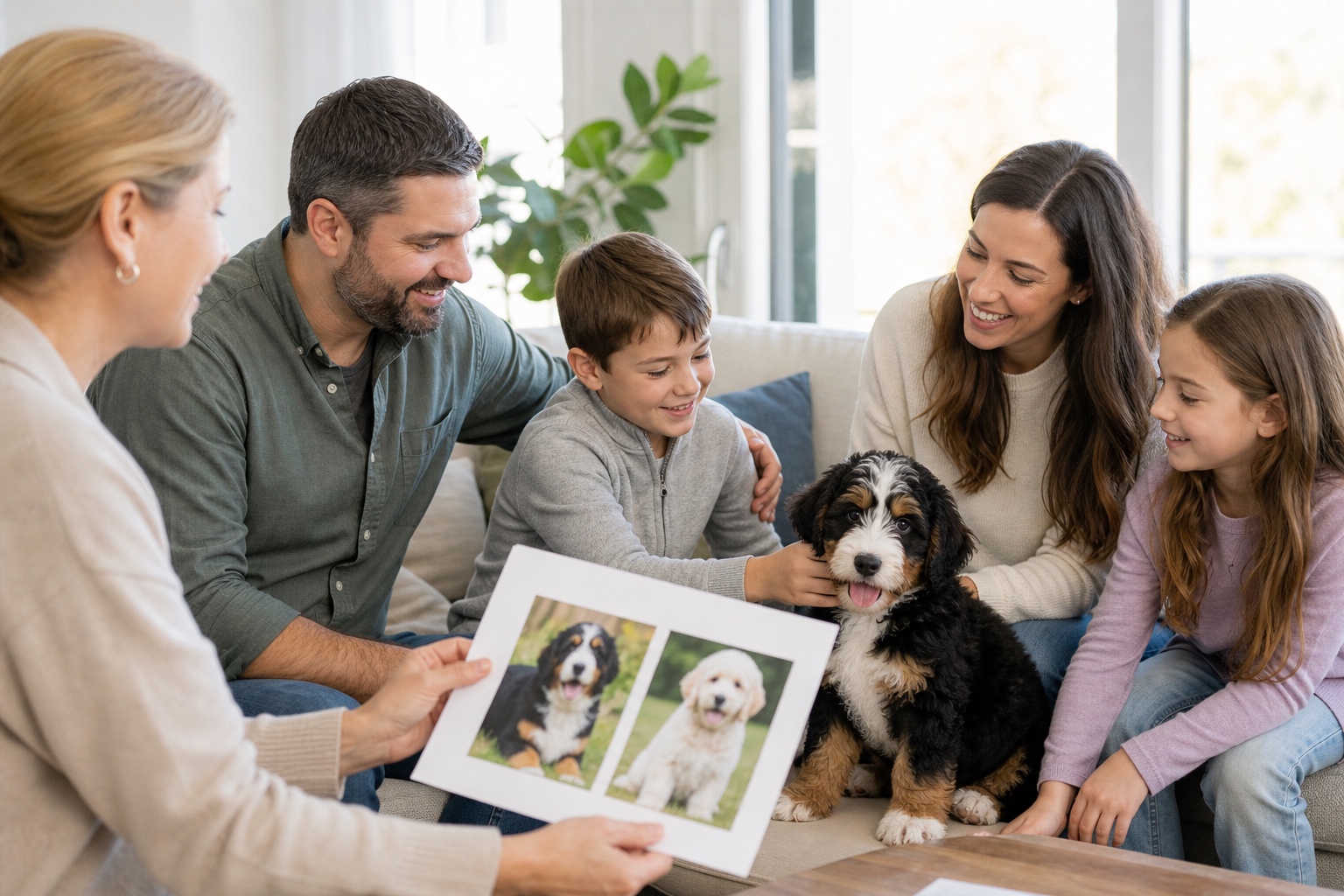
At Red Barn Doodles and More, we focus on thoughtful pairings, fully health-tested parent dogs, family-oriented raising, and open communication. We help families look beyond color or generation labels to consider temperament, coat care, size, and everyday fit. Transparency means explaining both what we know and what no breeder can promise.
Meet the dogs on Parents, learn more on About, and use Contact when you want help comparing a particular litter.
Frequently Asked Questions
What is the main difference between an F1 and F1B Bernedoodle?
An F1 is a Bernese Mountain Dog-Poodle cross. An F1B is commonly an F1 Bernedoodle crossed back to a Poodle. Ask the breeder to confirm the actual parents.
Does an F1B Bernedoodle shed less than an F1?
F1B coats may trend curlier and lower-shedding, but there is no guarantee for an individual puppy.
Is an F1B Bernedoodle hypoallergenic?
No dog is guaranteed to be allergen-free. Families with allergies should seek medical guidance and make a careful, individualized decision.
Which generation is easier to groom?
Neither is automatically easy. Curlier coats can hold loose hair and mat; wavier coats also tangle. The best routine depends on the actual coat and length.
Which Bernedoodle generation has the best temperament?
Generation alone cannot answer that. Parent temperament, individual puppy behavior, early environment, and family training matter more.