Merle in Doodles: Blue Merle, Cryptic Merle, and What It Means for Families
Merle in doodles: why families ask about it
If you’ve been browsing doodle puppies online, you’ve probably seen the word merle—often paired with stunning photos and names like “blue merle.” Merle coats can be striking, and it’s normal to have questions before you decide what’s right for your family.
This article breaks down merle in plain English:
- what blue merle doodle coloring typically looks like
- what a cryptic merle bernedoodle is (and why it can be confusing)
- how merle fits into common doodle coat patterns
- what to ask your breeder so you feel confident and informed
We’ll keep this warm, practical, and family-focused—especially for first-time puppy owners.
What is merle (in simple terms)?
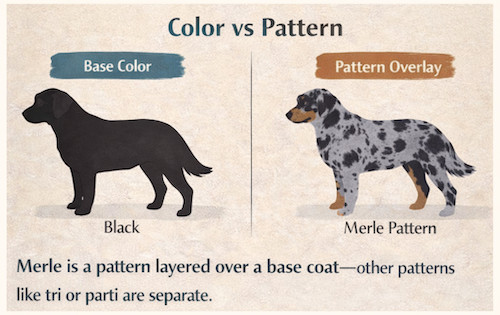
Merle is a coat pattern that creates a marbled or mottled look—often with patches of lighter and darker pigment. It can show up in different colors depending on the dog’s base coat.
A few important clarifications:
- Merle is not a “color” by itself—it’s a pattern laid over a base color.
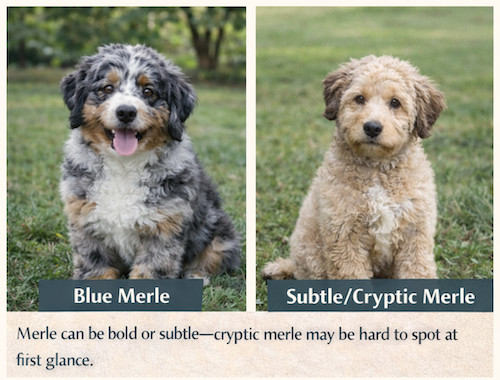
- Merle can range from very obvious to hard to notice.
- Two merle dogs can look completely different even if they’re both “merle.”
When someone says “merle,” they may be referring to:
- a clearly visible merle pattern (like classic blue merle)
- a subtle form of merle (like cryptic merle)
- or sometimes a dog with a different pattern that gets mislabeled online
That’s why it helps to understand the basic categories.
Blue merle doodle: what it usually looks like
Blue merle typically describes a dog with:
- a black base coat
- diluted/marbled areas that appear gray/silver
- often with black patches throughout
It’s one of the most recognizable merle looks, and it tends to photograph dramatically—which is why it’s so popular on social media.
Common markings families notice
- marbling across the body or shoulders
- darker patches (“ink spots”)
- sometimes white markings (depending on other pattern genes)
- sometimes tan points (if the dog is tri/phantom patterned as well)
Because doodles are mixes, the final look depends on several genes working together—not merle alone.
Cryptic merle Bernedoodle: what it is and why it surprises people
A cryptic merle bernedoodle (sometimes called “hidden merle”) is a dog that carries the merle pattern, but the pattern may be:
- extremely faint
- limited to a small area (like an ear or tail)
- hard to see without close inspection
- not obvious until the coat changes with age/grooming
Why cryptic merle confuses families
From a family’s perspective, cryptic merle can be surprising because:
- the puppy might be listed as “solid” or “non-merle” based on appearance
- the merle pattern might become more noticeable later
- people may disagree on labels just by looking at photos
The takeaway: “Merle” can be visible or subtle, and appearance alone isn’t always reliable.
Merle genetics: the non-scary version
When you see the phrase merle genetics, it can feel intimidating. You don’t need to be a scientist to ask smart questions, though.
Here’s the family-friendly way to think about it:
- Merle is controlled by a gene that affects how pigment shows up in the coat.
- A dog can have merle that’s obvious or cryptic.
- Merle can also stack with other coat patterns, changing the final look.
Why transparency matters
Because merle can be subtle, the safest route is always:
- clear breeder communication
- accurate labeling
- willingness to explain parents and patterns
A breeder should be able to tell you why a puppy looks the way it does and what patterns are present in the parents.
Doodle coat patterns: how merle fits in
Families shopping for puppies often mix up “color” and “pattern.” Here are a few terms you’ll see in doodles and Bernedoodles:
Patterns often seen in doodles
- Parti: mostly white with large colored patches
- Phantom: defined “points” (like eyebrows/legs/chest) with a darker base
- Tri-color: three colors (often a base + white + points)
- Sable: hairs with darker tips creating shading
Merle can appear alongside these patterns, which is why descriptions can get long (and confusing) fast.
Example: a puppy could be described as “blue merle tri” or “merle phantom.”
That doesn’t mean it’s “more merle”—it means merle is showing on top of other pattern genetics.
What merle means for families choosing a puppy
Most families care about three things:
- What will my puppy look like as they grow?
- How confident can I feel about what I’m being told?
- Is the breeder transparent and ethical?
Merle can be beautiful, but here’s the practical reality:
- Coat appearance can change with maturity and grooming.
- Photos can be misleading depending on lighting and filters.
- Labels online are inconsistent (especially in classifieds).
So instead of focusing on the “perfect merle look,” focus on:
- the breeder’s clarity
- the parents
- what past puppies matured into
- the puppy’s temperament fit for your family
What to ask a breeder about merle (quick checklist)
If you’re considering a merle puppy, these questions help you avoid confusion:
About the parents
- Which parent carries merle, and how does it show up?
- Can I see photos of both parents in natural light?
About the puppy
- Is the puppy visibly merle or considered cryptic merle?
- What coat patterns are present (merle, tri, phantom, parti, etc.)?
About expectations
- How might this coat change as the puppy matures?
- Do you have examples of older dogs from similar pairings?
A trustworthy breeder will welcome these questions and explain without pressure.
Curious whether a specific puppy is merle, cryptic merle, or another pattern entirely?
How our program helps
At Red Barn Doodles and More, we believe families deserve straight answers—especially with confusing topics like coat patterns.
Here’s what we prioritize:
- Ethical breeding practices and thoughtful pairing decisions
- Transparency about parents, patterns, and what we’ve seen in past puppies
- Support for first-time owners so you know what to expect before and after pickup
- A calm, no-pressure experience where your questions are always welcome
Learn more about Red Barn Doodles & More:
FAQ
What is a blue merle doodle?
A blue merle doodle typically has a black base coat with gray/silver marbling and darker patches. It’s a coat pattern, not a single “color.”
What does cryptic merle mean?
Cryptic merle means the dog carries the merle pattern, but it may be very subtle or limited to a small area, making it hard to see in photos or at first glance.
Can merle show up later as the puppy grows?
Coats can change as puppies mature and are groomed, and subtle patterning can become more noticeable over time. A breeder can share what they typically see from similar pairings.
Is merle the same thing as parti or tri-color?
No. Parti and tri-color describe different coat patterns. Merle can sometimes appear alongside other patterns, which is why descriptions can get detailed.
What should I look for when choosing a merle puppy?
Look for transparency: clear info about the parents, honest explanations of coat patterns, and examples of past puppies. Then make sure temperament and lifestyle fit come first.
If you’re considering a merle puppy and want help understanding patterns, parents, or what to expect as your puppy grows:
Apply here → Puppy Application
Or contact us with questions → Contact
You can also learn more about our dogs here: Parents and About
And see current/upcoming pups here: Puppies for Sale